Making BuyAbility Details Trustworthy

This case study covers two separate, independently shipped initiatives, both living inside the BuyAbility Details experience, the space where users go to understand exactly how their number was calculated. Both tackle the same root problem: the number looked complete, but was quietly hiding something from the user.
Completion Date
June 2026
Category
Product Designer, Affordability Team
Sector
Financial, Real State
Initiative A — Closing Costs
BuyAbility ignored the 2–5% in closing costs required at purchase, overstating what buyers could actually afford — 38% of buyers didn't fully anticipate this cost going in.
The Challenge
The real fix here was conceptual, not visual: reframe the number around "cash to close" instead of just down payment. But most users don't reliably understand what "cash to close" means, while existing users already had a working mental model built around down payment. Educate the new without breaking the old. That tension shaped every decision on this project.

My Contribution
Designed an interim solution that surfaced closing costs plainly, with light educational context to orient users. Coordinated with the HDP team for approval, since this needed to reflect there as well. Made sure the solution extended to web, not just app, so the fix was consistent everywhere buyers encountered their number. Here an example on how some of the BuyAbility channels did not cover any information regarding closing costs:
The Solution & The Outcome
An interim, education-forward surfacing of closing costs, designed to bridge new users and existing "down payment" mental models rather than force a hard reframe. We shipped as an interim, education-forward solution that closed one of the most common financial surprises in the home-buying journey, while identifying "cash to close" as the clear next evolution of the work.

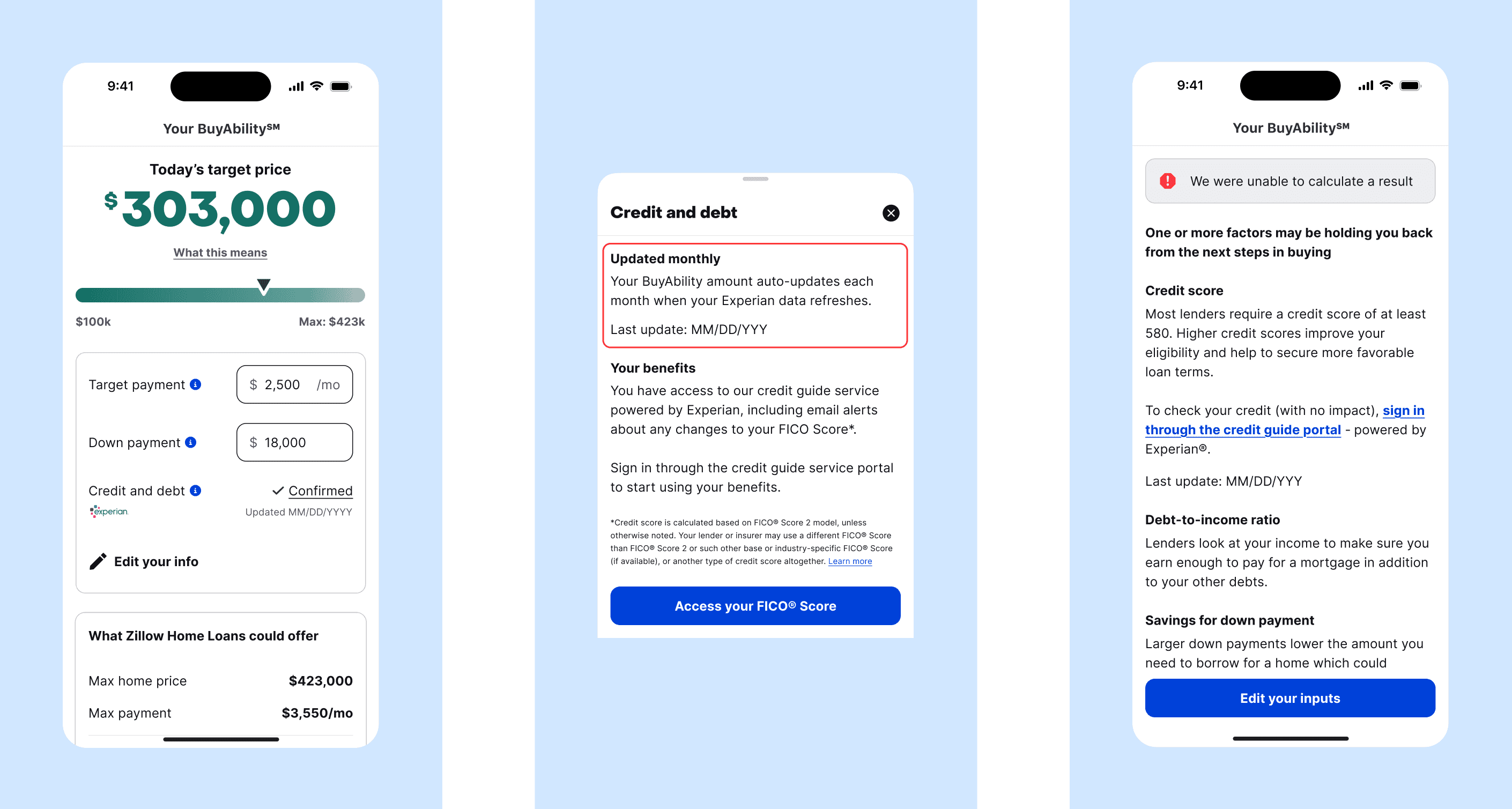
Users connected to Experian to verify their numbers but had no way to know when that data was last checked, so they couldn't tell if their BuyAbility number was current.
The Challenge
Inside BuyAbility Details, a Credit & Debts section requires users to connect securely to Experian (no score impact) to verify their numbers. Once enrolled, though, the experience went dark — there was no signal for whether that data was fresh or stale. Silence reads as untrustworthy, especially in a space where trust was already fragile.
My Contribution
Ramped up on an unfamiliar system: learned how the Experian data pipeline worked and how it was currently reflected in the UI across every state. Explored simple ways to surface a "last updated" signal without over-investing design time in a deliberately small-scoped project. Landed on a date-stamp treatment after design reviews with team/manager, then content and legal sign-off.
Deliverables
Research, UI Design, Content Strategy, Cross-platform Design (Web + App)